
How to Perform a Visual Posture Assessment: A Guide for Trainers and Movement Professionals
Posture Analysis Guide. Know your client at first sight.
Updated June 2026
By Nannette Chacon, NASM CPT, CES, E-RYT
Understanding posture and movement assessment is one of the most valuable skills a trainer, yoga instructor, or movement professional can develop. Before strength, flexibility, mobility, or performance can improve, we must first understand how the body organizes itself in standing, walking, sitting, and movement.

Related Resources:
Why is posture analysis important?
Could it be that incorrectly trained muscles, poor movement habits, and long-standing compensation patterns can contribute to musculoskeletal imbalances, reduced performance, chronic discomfort, and stalled progress?
Why overlook the details?
When we understand how the body naturally positions itself, we begin to understand where movement limitations originate. Visual posture analysis helps us identify potential mobility restrictions, muscular imbalances, movement compensations, and areas of weakness before they become obstacles.
Think of the body as a biological machine. If a machine is assembled incorrectly, it will eventually wear down. The human body is no different. The difference is that we only get one.
“Art calls for complete mastery of techniques, developed by reflection within the soul.”
-Bruce Lee

Removing Old Ideas and Concepts: Freedom to Create
Let’s leave rigid thinking behind while keeping the tools we already have.
I’m not here to teach the next trendy exercise or movement hack. You already have your exercises, your training methods, and your favorite yoga postures.
What I hope to offer is a framework for understanding human movement at a deeper level.
The better we understand alignment, posture, and movement mechanics, the more freedom we have to modify, improve, and personalize our training programs.
The details matter...
As trainers and instructors, we can sometimes become so focused on exercises that we forget the structure performing the exercise. There are no shortcuts when building the human body. Even the strongest individuals have weak points, and eventually those weak points become limiting factors.
Know Your Client at First Sight
One of the most valuable skills I learned through posture correction training and years working in clinical and rehabilitation environments is how much information the body reveals before a client performs a single exercise.
A visual assessment can reveal:
Potential movement restrictions
Muscular imbalances
Postural compensations
Breathing dysfunctions
Mobility limitations
Areas of weakness
Habitual movement patterns
Your client will always have their version of the story. Listen carefully.
But also trust what the body is showing you.
The body rarely lies.
Curious How These Concepts Apply to Your Own Body?
Posture is more than standing up straight. The way you sit, walk, bend, breathe, and move throughout the day can influence mobility, strength, and overall movement quality.
If you’re dealing with recurring aches and pains, movement limitations, or simply want to better understand your posture and alignment, I offer a complimentary Virtual Movement & Alignment Evaluation.
Together we’ll identify movement patterns, compensation strategies, and opportunities to improve efficiency, mobility, and performance.
👉 Schedule your complimentary evaluation to learn more about how your body moves.
What Should We Observe First?
Before movement testing begins, I like to observe:
Standing Posture
Sitting Posture
Gait Pattern
Sit-to-Stand Transitions
Bending and Lifting Mechanics
These are movements your client performs hundreds of times throughout the week.
No matter how athletic or strong someone is, these daily movement patterns often reveal the true foundation beneath their performance.
Watch how they move naturally.
Observe them before they become aware that they are being assessed.
Those unconscious movement habits often provide the greatest insights.

Posture Assessment From the Ground Up
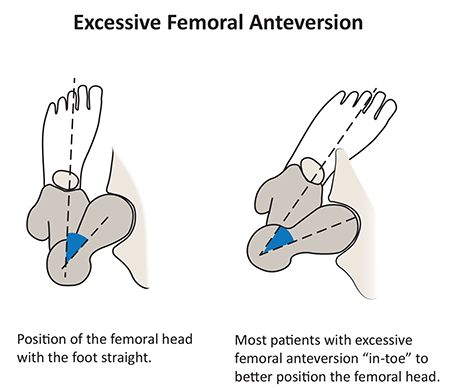
Foot Position and Femoral Rotation
This is where I begin.
Foot position and femoral orientation can significantly influence pelvic mechanics, movement patterns, and overall posture throughout the body.
Externally rotated femurs are common, though internal rotation patterns certainly exist as well.
When femoral alignment becomes excessive, compensation patterns often begin to appear throughout the kinetic chain.
Potential findings may include:
Foot pronation or collapsing arches
Hip imbalances
Uneven muscle development
Altered gait mechanics
Knee tracking issues
Repetitive stress injuries
Because the femur is such a large structural component of the body, changes in its orientation can affect how the pelvis and spine organize themselves.


Following the Spinal Curves
Once I assess the lower body, I begin following the natural curves of the spine.
Pelvic Position
The pelvis serves as an important bridge between the lower body and the spine.
Common presentations include:
Anterior Pelvic Tilt
Posterior Pelvic Tilt
Neutral Pelvis
A posterior pelvic tilt often presents with a flattened lumbar spine and tucked pelvis.
An anterior pelvic tilt typically presents with an increased lumbar curve and may contribute to rib cage flare.
The goal is not perfection.
The goal is understanding how the pelvis influences the rest of the body.

Rib Cage Position
One of the most overlooked aspects of posture assessment is rib cage positioning.
The rib cage plays a major role in:
Breathing mechanics
Core function
Spinal positioning
Shoulder mechanics
Thoracic mobility
The thoracolumbar junction is often where we begin to notice changes in spinal organization.
The rib cage should not remain excessively flared or locked into extension.
Instead, we want the rib cage to stack naturally over the pelvis while allowing efficient breathing and movement.
This area alone can dramatically affect posture correction outcomes.


Shoulder and Head Position
As we continue up the chain, we arrive at the shoulders and head.
Ideally, the shoulders rest comfortably along the sides of the body without excessive protraction or retraction.
The head should remain balanced over the torso rather than drifting excessively forward or backward.
Many neck and shoulder issues are actually reflections of compensations occurring lower in the body.
This is why posture assessment should always be approached globally rather than focusing on isolated body parts.


The Centerline

The Centerline Concept
Throughout this guide we have analyzed the body from the ground up: foot positioning, femur alignment, pelvic orientation, rib cage position, spinal curves, shoulder placement, and head posture.
At first glance these may appear to be separate corrective strategies. In reality, they all serve the same purpose:
Restoring the body toward its centerline.
The Centerline Theory originates from Wing Chun martial arts, where maintaining control of the body’s central axis allows for greater efficiency, stability, balance, and force production. While originally developed for combat and self-defense, the concept translates remarkably well into rehabilitation, corrective exercise, movement optimization, and postural restoration.
In movement science, the centerline can be thought of as the body’s primary reference axis the line running through the center of the head, rib cage, pelvis, and lower extremities.
Modern postural restoration follows a similar principle: bringing structures back toward their ideal relationship with the body’s center.
The head is guided toward center.
The rib cage is guided toward center.
The pelvis is guided toward center.
The femurs, knees, and feet are guided toward center.
This does not imply rigid or perfectly symmetrical positioning. Rather, it reflects the body’s ability to organize itself efficiently around a stable central axis.
When the body drifts away from this centerline, compensations often emerge:
Forward head posture moving the head away from center.
Rib cage flare moving the thorax away from center.
Pelvic shift, rotation, or tilt moving the pelvis away from center.
Excessive femoral rotation affecting lower extremity alignment.
Knee valgus or varus positioning.
Weight shifting predominantly into one leg rather than balancing around the body’s axis.
The body is constantly attempting to organize itself around this central reference point.
Why It Matters
One of the primary goals in rehabilitation, sports medicine, and corrective exercise is often not simply to strengthen muscles, but to restore efficient positioning.
When structures are centered:
Force transfers more efficiently.
Joint loading becomes more balanced.
Breathing mechanics improve.
Stability increases.
Energy expenditure decreases.
Movement becomes more coordinated.
Athletic performance improves.
When alignment, stability, and strength are restored toward the body’s center, movement quality improves and compensation patterns begin to decrease.
Applying the Concept
Rather than viewing posture as a collection of isolated body parts, we can observe how each structure relates to the centerline:
✓ Head balanced over rib cage
✓ Rib cage stacked over pelvis
✓ Pelvis centered between the hips
✓ Femurs tracking beneath the pelvis
✓ Knees aligned over feet
✓ Weight distributed evenly through both lower extremities
In this sense, posture correction becomes less about forcing perfect positions and more about helping the body organize itself around a stable central axis.
A Practical Example
Imagine a client presenting with:
Forward head posture
Rib cage flare
Anterior pelvic tilt
Externally rotated femurs
At first glance these appear to be four separate problems.
Through a centerline lens, however, they may represent a body that has progressively drifted away from its central axis.
The corrective strategy becomes restoring organization around the centerline:
Improve rib cage positioning.
Restore pelvic control.
Improve femoral alignment.
Re-establish head and neck positioning.
Reinforce balanced movement patterns.
Now the body can distribute force more efficiently throughout the entire system.
Whether viewed through the lens of martial arts, rehabilitation, sports medicine, biomechanics, or corrective exercise, the principle remains remarkably similar:
A body organized around its centerline is a body capable of moving with greater efficiency, stability, and power.
Staying True to Form
The body functions best when its major structures work together.
Mobility and stability are not opposing forces.
They are partners.
Many movement limitations occur because the body’s foundation has become unstable.
Before forcing more mobility into a joint, it is often worth asking whether the surrounding structures are providing adequate support.
Sometimes the answer is not more stretching.
Sometimes the answer is better positioning.
Final Thoughts
Checking your client’s natural posture while they are unaware can tell you an incredible amount about their movement habits and daily patterns.
In many cases, an entire corrective exercise strategy can begin with a careful visual assessment.
Learn to observe.
Learn to recognize patterns.
Learn to connect structure with function.
The more deeply you understand posture, the more clearly you understand movement.
“When one has reached maturity in the art, one will have a formless form. It is like ice dissolving in water. When one has no form, one can be all forms; when one has no style, he can fit in with any style.”
— Bruce Lee
✨Are You a Trainer, Yoga Teacher, or Movement Professional?
Understanding posture is one thing.
Learning how to apply posture analysis to real people, real movement patterns, and real exercise programming is another.
If you’re a trainer, instructor, coach, or movement professional looking to deepen your understanding of posture assessment, biomechanics, movement analysis, and corrective exercise strategies, I’d love to connect.
I offer mentorship, professional consultations, and movement education sessions designed to help instructors build confidence in their assessment skills and programming decisions.
📩 Interested in collaborating or learning more? Reach out to discuss mentorship, continuing education, or professional development opportunities.


Comments